
What Is a Cantilever Gate and How Does It Work?
What is a cantilever gate? Learn how this track-free sliding gate works, where it fits, and what to plan for on Arkansas residential and commercial sites.
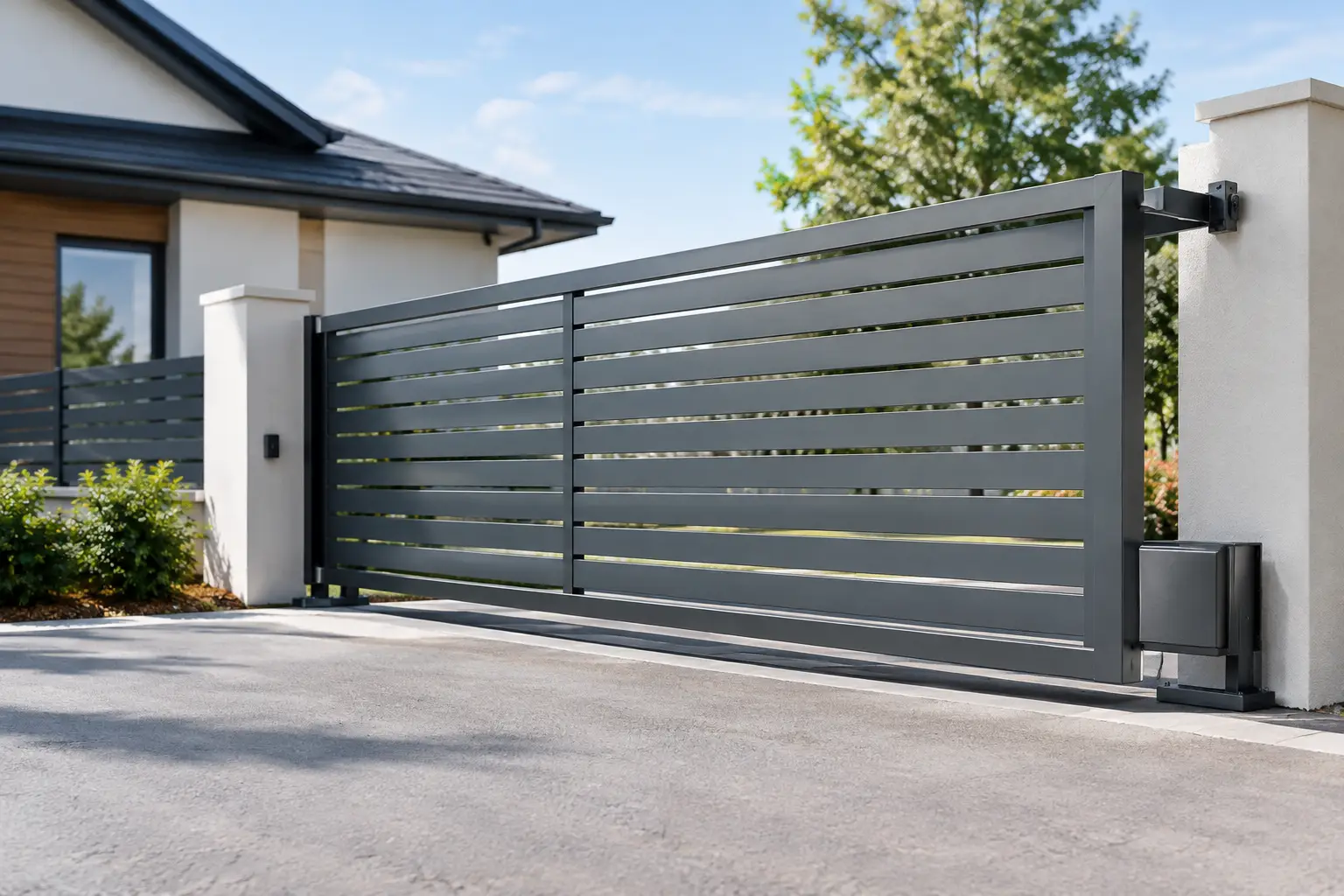
A driveway gate that drags across gravel, mud, leaves, or uneven pavement will eventually become a service issue. That is the practical reason many commercial sites choose cantilever systems. What is a cantilever gate? It is a sliding gate that moves sideways across an opening without a wheel or track touching the ground. Instead, the gate is supported by roller assemblies mounted to posts beside the opening.
For property owners in Fort Smith, Northwest Arkansas, and the River Valley, that track-free design can make a major difference. Rain, runoff, gravel drives, farm traffic, and changing ground conditions can all interfere with a conventional rolling gate. A properly designed cantilever gate keeps its moving parts above those obstacles while providing controlled access to a property.
What Is a Cantilever Gate?
A cantilever gate is a horizontal sliding gate supported from one side of the gate opening. The gate frame extends beyond the clear opening to form a counterbalance section, often called the tail. That extra section rides through heavy-duty rollers attached to structural support posts.
When the gate opens, the entire frame slides parallel to the fence line. Nothing spans the driveway at ground level. The gate panel remains suspended several inches above the surface, allowing vehicles to pass without crossing a rail, track, or groove.
The word "cantilever" describes the way the gate is supported. Rather than resting on wheels at each end, the frame is carried by rollers on one side. This approach requires a longer run of fence beside the opening, but it eliminates many of the problems associated with ground-track sliding gates.
Cantilever gates are commonly built with chain link fabric and steel framework, but they can also be designed with ornamental steel, privacy panels, welded wire, or other materials suited to the surrounding fence. They are frequently used at commercial yards, industrial facilities, utility sites, storage properties, apartment communities, and farms. They can also be a strong choice for residential driveways where terrain or driveway conditions make a swing gate impractical.
How a Cantilever Gate Works
The working parts are straightforward, although sizing and installation need to be precise. A typical system includes a reinforced gate frame, two roller assemblies, support posts, guide rollers, end stops, and a latch or receiver post. If the gate is automated, it also includes an operator, safety devices, controls, and electrical components.
The gate frame has a lower rail shaped or sized to fit within the roller assemblies. As the gate moves, the rollers support and guide that rail. The upper guide hardware keeps the frame upright and aligned. At the fully open and fully closed positions, stops prevent the gate from traveling too far.
Because the gate needs a counterbalance tail, it is longer than the driveway opening itself. As a general rule, the total gate length is the clear opening plus approximately one-half of that opening for the counterbalance section. A 20-foot opening, for example, may need roughly 30 feet of clear fence line beside it. The exact length depends on gate height, weight, material, hardware, wind exposure, and the system manufacturer’s specifications.
That added length is one of the first details to review during site planning. A cantilever gate may be an excellent mechanical fit for a property but still require more side room than the layout allows.
Why Property Owners Choose Cantilever Gates
The main advantage is reliability in difficult ground conditions. A wheel-supported slide gate depends on a clean, level path. A low spot, washout, ice buildup, loose stone, or debris in the track can stop it from rolling properly. A cantilever gate clears the ground, so ordinary surface debris is less likely to affect operation.
This design also works well where a driveway slopes near the entrance. Swing gates need clearance across their full arc, and rolling gates need a relatively level travel path. A cantilever gate does not solve every slope issue, but its elevated frame can provide more flexibility around uneven approaches.
For commercial and industrial sites, cantilever gates also support wide openings and frequent use. They can be built for substantial spans and paired with access-control equipment such as keypads, card readers, telephone entry systems, remote controls, loop detectors, and automatic operators. That makes them useful where employees, deliveries, customers, or service vehicles need controlled entry throughout the day.
Security is another reason to consider this gate type. A well-built steel cantilever gate can match the height and strength of the surrounding perimeter fence. With the right latching, operator controls, and safety equipment, it creates a defined vehicle entrance rather than an open break in the fence line.
Cantilever Gate vs. Other Gate Types
There is no single best gate for every property. The correct choice depends on available space, traffic patterns, budget, security requirements, and the condition of the entrance.
A swing gate is often a good option when there is room for the leaves to open inward or outward and the driveway is relatively level. It can be simpler in some residential settings and does not require the extra side run of a cantilever gate. However, wind load, slope, snow or debris clearance, and the swing path all need consideration.
A tracked slide gate can be appropriate for certain sites, especially where the surface is paved, level, and maintained. It generally does not require as much counterbalance length as a cantilever system. Its trade-off is the ground track. On gravel, dirt, or heavily traveled entrances, keeping that track clean and properly aligned can require more attention.
A cantilever gate is usually the better fit when a property needs a sliding gate but cannot depend on a clean track across the driveway. It is particularly practical for uneven, unpaved, or debris-prone surfaces. The trade-off is a higher level of structural hardware and the need for adequate room along the fence line.
Planning the Right Cantilever Gate
A gate should be planned as part of the full perimeter and traffic system, not treated as an afterthought. The clear opening must accommodate the largest vehicle expected to enter. A passenger-car driveway may need far less width than an entrance used by delivery trucks, trailers, fire apparatus, or agricultural equipment.
The amount of space beside the opening matters just as much as the opening width. The gate needs room to travel completely out of the way when open. A fence corner, retaining wall, utility equipment, trees, or a change in grade can limit the available run and affect the design.
The support posts and foundations are equally important. Cantilever gates place concentrated loads on their support structure, especially on wider or taller gates. Post size, footing depth, concrete volume, soil conditions, gate weight, and local wind exposure should all be considered before installation. A gate that looks properly aligned on day one can develop operating issues if the posts or footings are undersized.
Material selection should match the purpose of the site. Galvanized chain link is a practical choice for many commercial yards and utility areas. Ornamental steel may be better suited to a visible business entrance or upscale residential property. Privacy infill can limit sightlines, but it also increases wind load, which may require a stronger frame and support system.
Automation and Safety Considerations
A manual cantilever gate can work well for low-traffic properties, but frequent use often calls for an automatic operator. Automation can improve convenience and access control, particularly at businesses, managed properties, and secured facilities. It also introduces additional planning needs.
The operator must be correctly sized for the gate’s weight, length, duty cycle, and expected number of daily openings. A light residential operator is not the right choice for a heavy commercial gate that cycles throughout the day. Electrical service, battery backup, controls, emergency access, and operator placement should be addressed before the gate is installed.
Safety equipment is not optional on an automated system. Depending on the application, this may include photo eyes, monitored edge sensors, vehicle detection loops, warning devices, and properly placed controls. The gate area should be designed to prevent people from reaching pinch points, climbing on the gate, or entering the path of a moving system.
A properly installed gate also needs routine attention. Keep the travel area clear, inspect rollers and guides, check hardware for wear, and make sure safety devices operate as intended. After severe weather, vehicle impact, or noticeable changes in movement, the system should be inspected before continued use.
Is a Cantilever Gate Right for Your Property?
A cantilever gate is often the right solution when dependable sliding access is needed over an uneven, gravel, dirt, or debris-prone driveway. It is also a strong option for sites that need a wide opening, commercial-grade access control, or a gate that matches a security-focused perimeter fence.
It may not be the best fit if the property lacks enough side room for the gate to retract, if a swing gate has ample clearance and better suits the layout, or if the project budget does not support the heavier structure and hardware required. The best decision comes from evaluating the entrance, the traffic using it, and the level of security the property needs.
Ace Fence Company Inc. helps property owners plan gate systems around real site conditions, from basic driveway access to commercial and specialty perimeter installations. A clear layout, properly sized structure, and appropriate controls will do more for long-term gate performance than choosing a design based on appearance alone.
Ready to Talk to a Real Fence Professional?
Free on-site estimates from the River Valley's most trusted fence company since 1963.