Swing Gates Versus Sliding Gates Compared
Compare swing gates versus sliding gates for your Arkansas property. See how space, traffic, terrain, security, and automation affect the right choice.
A gate has to do more than mark the entrance to a property. It needs to fit the driveway, handle daily traffic, work with the terrain, and provide the level of security the site requires. When comparing swing gates versus sliding gates, the right answer usually comes down to the space available and how the entrance will be used.
A residential driveway with a wide, level approach may be well served by a traditional swing gate. A busy commercial entrance, storage yard, or industrial site may need a sliding or cantilever gate that keeps the driveway clear and accommodates frequent vehicle access. Both systems can be built for dependable operation, but they solve different problems.
Swing Gates Versus Sliding Gates: The Main Difference
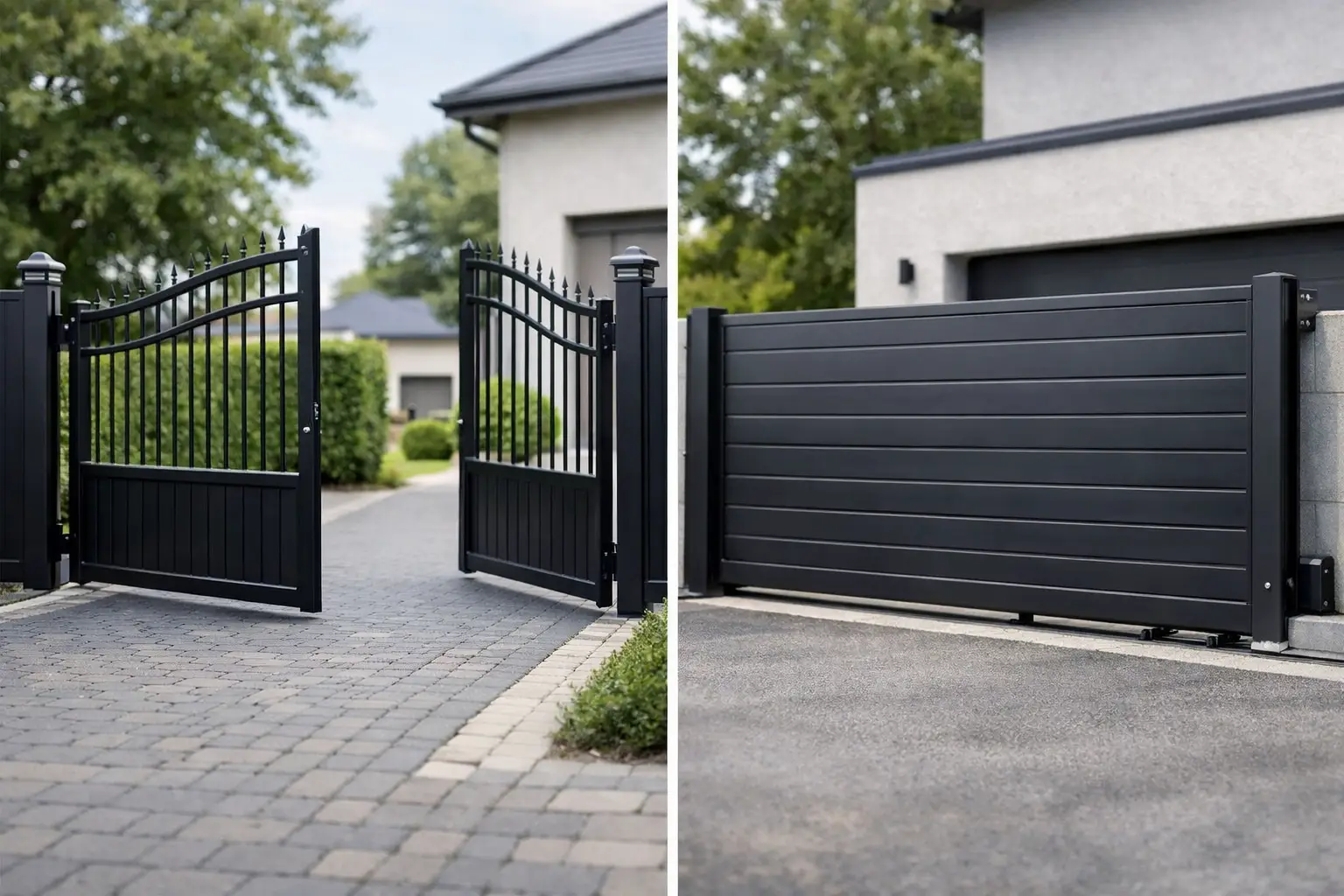
Swing gates open on hinges, much like a door. They may be single-leaf gates that swing from one side or double gates with two leaves that meet in the middle. The gate can swing inward toward the property, outward toward the road where allowed, or in some cases in either direction depending on the hinge and operator setup.
Sliding gates travel sideways along the fence line. A conventional slide gate rolls on wheels along a track or guided surface. A cantilever sliding gate is supported above the driveway opening, extending back along the fence line without a ground track across the vehicle path. This design is common for commercial and security-focused locations where dependable clearance matters.
The difference seems simple, but it affects everything from site preparation and automation to vehicle flow and long-term maintenance.
When a Swing Gate Makes Sense
Swing gates are a strong choice when there is enough clear space inside the property for the gate leaves to open fully. They are especially common at homes, farms, private drives, and decorative entrances because they can provide a traditional appearance while working with wood, ornamental steel, vinyl, chain link, and other fence materials.
For a typical residential driveway, a double swing gate can create an attractive, balanced entrance without requiring a long stretch of open fence line to one side. It may also be more practical where the driveway is narrow but the property has open space behind the gate.
Swing gates can be manual or automated. For low-traffic entrances, a properly installed manual gate may be all that is needed. For homeowners who regularly enter and leave by vehicle, an automatic operator can add convenience while keeping the gate closed when it is not in use.
Space and driveway grade matter
A swing gate needs a clear arc of travel. Landscaping, parked vehicles, retaining walls, curbs, and a rising driveway can interfere with that arc. A gate that swings inward also needs room between the gate and any vehicle waiting to enter.
Driveway slope deserves close attention. If the ground rises sharply inside the gate, a standard swing gate may scrape the pavement or require a different design. A sloped entrance does not automatically rule out a swing gate, but it should be evaluated before fabrication and installation.
Strengths of swing gates
Swing gates generally have fewer moving components than sliding systems and can be an economical option for the right opening. They work well for shorter driveway spans, offer considerable design flexibility, and make a natural fit for many residential properties.
Their limitations are mostly site-related. They are less suitable for areas with limited swing clearance, frequent truck traffic, steep grades, or high winds. Long or heavy swing leaves also place substantial demands on posts, hinges, and operators, so proper construction is essential.
When a Sliding Gate Is the Better Choice
A sliding gate is often the practical answer when a swing gate would block the driveway or lack enough room to open. Because the gate moves parallel to the fence, it does not need a clear area inside the drive. That makes it useful near parking areas, loading zones, narrow entrances, and roads where an outward-swinging gate is not appropriate.
Sliding gates are frequently used for commercial properties, equipment yards, apartment communities, industrial facilities, and controlled-access sites. They can cover wider openings than many swing-gate designs and are well suited to repeated daily use when paired with the correct operator and access controls.
A homeowner with a steep or constrained driveway may also benefit from a sliding gate. The system can keep the entrance functional without asking the gate to swing uphill, downhill, or into the path of parked vehicles.
Track slide gates and cantilever gates
A track slide gate rolls along the ground and is guided as it travels. It can be a reliable, cost-effective choice on a level, well-maintained surface. The track area does need regular attention, especially in places where gravel, leaves, mud, and debris collect.
Cantilever gates do not cross the driveway on a ground track. Instead, the gate is supported by rollers mounted on posts beside the opening. This avoids problems caused by track obstructions and allows vehicles to pass over the entrance without crossing a rail. For high-traffic commercial and industrial applications, cantilever systems are often preferred for their clearance and durability.
A cantilever gate does require additional space along the fence line. The gate must extend beyond the opening to counterbalance itself, so the available runback area should be measured early in the planning process.
Strengths of sliding gates
Sliding gates preserve clear driveway space, handle wider openings effectively, and can be a better match for frequent access. They are also easier to position behind the property line where vehicles can wait safely off the road before entering.
The trade-off is that sliding systems need enough side clearance for the gate to travel. They also require properly engineered posts, rollers or track components, and an operator sized for the weight and duty cycle of the gate. A gate that looks simple from the road can be a substantial access-control system behind the scenes.
Security, Traffic, and Automation
The gate style should match the way the property operates. A homeowner who opens a gate a few times a day has different needs than a warehouse with delivery trucks, employees, visitors, and after-hours access. Choosing a light-duty operator for a high-cycle entrance creates downtime and unnecessary repair costs.
For commercial and industrial sites, gate planning should account for vehicle type, daily traffic volume, opening speed, emergency access, and how long vehicles can safely wait before entering. A wide sliding or cantilever gate may be better for service trucks and trailers than a pair of swing leaves that reduce usable turning space.
Automation adds another layer of planning. Keypads, remotes, card readers, telephone entry systems, loops, safety edges, photo eyes, and exit devices can be integrated with either gate type. The operator and safety equipment must be selected for the gate design, location, and intended use. Automated gates should never be treated as a simple add-on after the fence and gate are already installed.
Wind exposure also matters. A solid privacy swing gate can act like a sail in strong weather, particularly when open. Open ornamental or chain link designs allow more air to pass through. Sliding gates can also be affected by wind, but their structural and operator requirements differ. The material, height, and infill should be considered along with the gate style.
Questions to Settle Before Choosing a Gate
Before selecting a swing or sliding system, look at the entrance as a working part of the property rather than a standalone feature. The most useful answers come from a site review: How wide is the opening? Is the drive level? Where can vehicles wait? Is there room for the gate to swing or slide? What type of vehicles use the entrance? How often will the gate operate?
It is also worth considering what the property may need a few years from now. A residential gate may eventually need an operator. A growing business may add staff, delivery traffic, or access-control requirements. Designing for the actual use case, with reasonable room for change, prevents the entrance from becoming a bottleneck.
Ace Fence Company Inc. helps property owners across Fort Smith, Northwest Arkansas, and the River Valley evaluate these details before installation. From residential driveway gates to commercial sliding, cantilever, and specialty access systems, the goal is to build an entrance that fits the site and holds up to its daily demands.
The best gate is not necessarily the one that looks best in a catalog. It is the one that gives your vehicles room to move, keeps the property controlled, and continues working when the gate is used day after day.
Ready to Talk to a Real Fence Professional?
Free on-site estimates from the River Valley's most trusted fence company since 1963.