Commercial Perimeter Security Guide
Our commercial perimeter security guide helps Arkansas property owners choose fencing, gates, and access control for safer, smarter sites.
A fence line usually gets attention after something has already gone wrong - a break-in, repeated trespassing, damaged equipment, or vehicles where they should not be. A good commercial perimeter security guide starts earlier, with a clear look at how your site is used, what needs protection, and how people should move through the property every day.
For commercial and industrial properties, perimeter security is rarely just about putting up a taller fence. The right setup has to fit the site, the traffic pattern, the level of risk, and the way your business operates. A warehouse has different needs than a school, a utility site, an apartment complex, or a construction yard. When those differences are ignored, owners often end up with a fence that looks substantial but leaves weak points at the gate, corners, or access points.
What a commercial perimeter security guide should cover
The perimeter is the full system, not a single product. That includes the fence itself, entry gates, gate operators, access control, and the layout around those components. It also includes practical details like visibility, emergency access, delivery traffic, and maintenance.
That is why the first question is not always, "What fence do I need?" A better question is, "What are we trying to prevent, and what traffic do we need to allow?" Some properties need to deter after-hours intrusion. Others need to guide vehicles through a single controlled point. Some need to separate public areas from restricted ones without making the site difficult for staff, tenants, or vendors.
A sound plan balances security with day-to-day use. If a system slows down operations too much, people find ways around it. If it is too light for the risk level, it may not do the job when it matters.
Start with the property’s real exposure
Every site has its own pressure points. A distribution yard may be vulnerable at wide vehicle openings. A retail service area may need to secure dumpsters, loading zones, and equipment behind the main building. A multi-tenant commercial property may struggle more with uncontrolled foot traffic than with heavy vehicle entry.
The layout matters as much as the material. Long runs along roads, alley access, blind corners, grade changes, drainage paths, and utility easements all affect how a perimeter should be built. In some cases, a standard fence line works well. In others, custom gate fabrication, cantilever systems, or specialty access solutions make more sense because the site conditions do not allow a one-size-fits-all approach.
This is also where budget should be discussed honestly. Not every property requires a maximum-security setup. But cutting too much at the design stage can create avoidable problems later, especially if the gate is undersized, the operator is not rated for the traffic, or the fence material does not fit the environment.
Choosing fence materials for commercial security
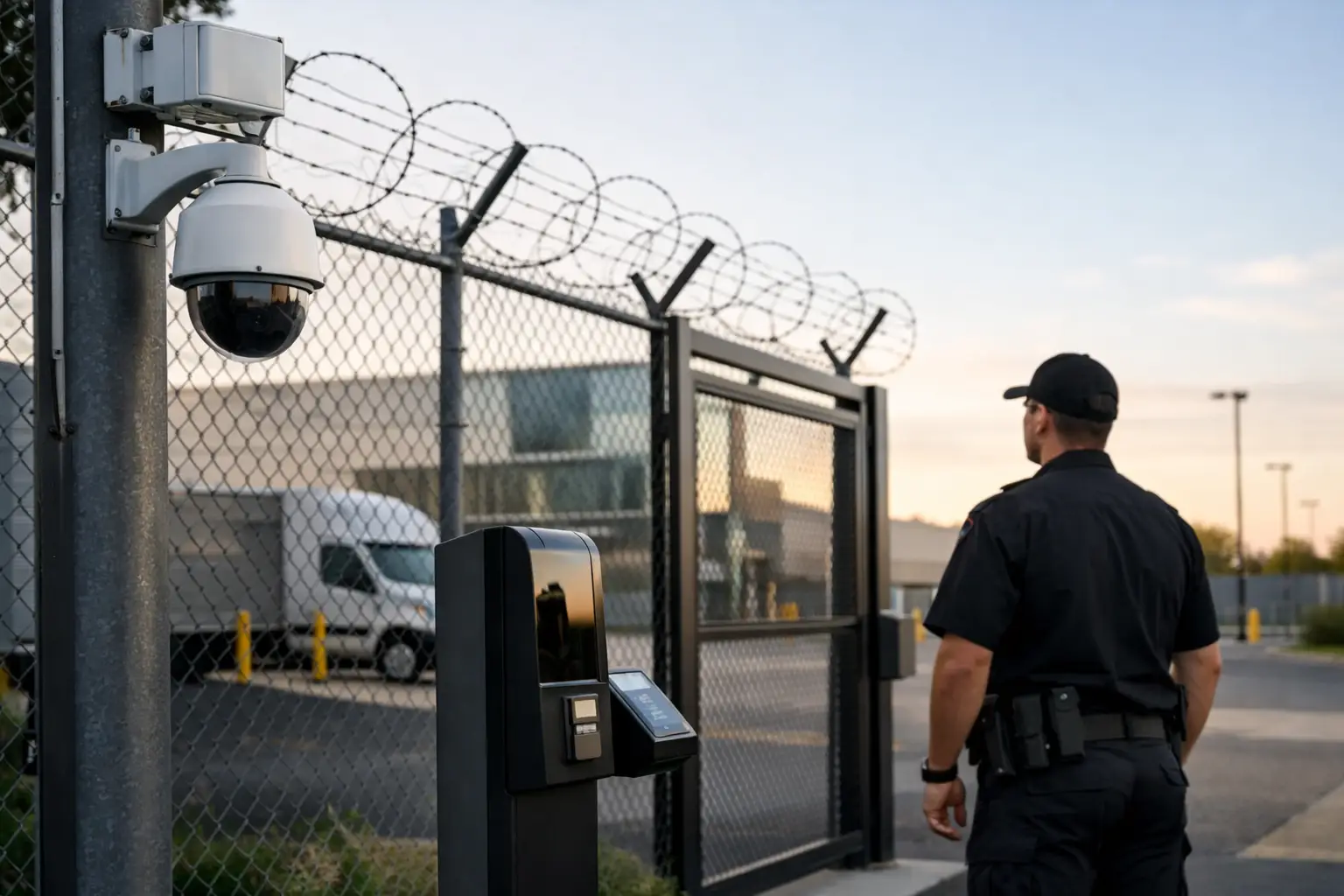
Chain link remains one of the most common commercial perimeter choices because it is economical, durable, and adaptable. For many businesses, it offers the right combination of security and visibility. It allows staff to monitor activity through the fence line, and it can be paired with barbed wire or privacy screening depending on the site’s needs and local requirements.
Ornamental metal fencing is often chosen when appearance matters alongside security. Office properties, schools, municipal facilities, and certain multifamily developments may want a cleaner finished look without giving up strength. It can define a property well, though it may not be the best fit for every industrial site or storage yard.
Wood, vinyl, and composite can serve commercial applications in the right setting, particularly where visual screening is the priority. A restaurant patio, apartment enclosure, or service area may benefit from privacy more than high-security performance. That said, if the concern is intrusion resistance around equipment, inventory, or fleet vehicles, those materials may need to be part of a broader strategy rather than the main security barrier.
The best material often depends on whether your priority is deterrence, screening, access control, appearance, or a mix of all four.
Gates are where security plans succeed or fail
A strong perimeter can be undermined by a poorly planned gate. That happens more often than many owners expect. The fence gets the most visual attention, but the gate handles the actual movement of people, trucks, deliveries, and service crews.
Swing gates can work well on some commercial sites, but they need room to operate and may not suit high-traffic or tight-clearance locations. Sliding and cantilever gates are often better for commercial properties because they manage vehicle access efficiently without requiring a large swing arc. Pivot lift gates may be the right answer where space, slope, or traffic demands make standard options impractical.
The gate also needs to match how the property functions. A light-duty operator on a gate that cycles all day will create service issues. A gate opening that is too narrow for regular truck traffic leads to damage, delays, and frustration. Emergency access must be considered up front, not after installation.
This is where working with a contractor that understands both fence construction and gate systems makes a difference. Security is not just a product selection. It is how those pieces work together under real use.
Access control should fit the people using it
Access control can be simple or advanced. Some sites only need keypad entry and reliable vehicle gate operation. Others need card readers, controlled schedules, telephone entry, or integrated systems that separate employee access from visitor access.
The right setup depends on how many users you have, how often they come and go, and how much oversight the property requires. A storage yard or service facility may need very different controls than a church, apartment complex, or manufacturing site. More technology is not always better if it adds complexity without solving a real problem.
A practical system should be easy for authorized users and difficult for unauthorized users. It should also be serviceable. If the site depends on daily controlled entry, downtime matters. That is one reason many owners prefer working with a contractor that can handle the physical perimeter and the access components as part of one plan.
The site itself affects security performance
Even the best fence and gate system can be weakened by conditions around it. Overgrown vegetation can reduce visibility. Erosion under the fence can create gaps. Poor drainage can affect gate alignment or operator reliability. Sloped ground may call for stepped panels, custom fitting, or a different gate style altogether.
Lighting, line of sight, and traffic flow should be considered with the perimeter, not after. If staff cannot clearly see who is entering, or if delivery vehicles back up at the gate because the approach is too tight, the system may create new risks while trying to solve old ones.
For Arkansas properties, weather and wear matter too. Heat, storms, moisture, and ongoing use all put pressure on commercial installations. Material selection and installation quality both affect long-term performance.
A commercial perimeter security guide is not complete without maintenance
Security systems are not set-and-forget. Hinges wear, rollers need adjustment, operators need service, and fence lines can be damaged by impact, weather, or ground movement. A small issue at the gate can become a major access problem if it is ignored.
Routine inspection helps catch problems early. It also protects the investment. A commercial perimeter should be looked at as working infrastructure, not just a boundary marker. If the property relies on it for daily access control, safety, and asset protection, maintenance has to be part of the plan.
That does not mean every site needs constant service calls. It means the system should be built correctly, used as intended, and checked often enough to keep it functioning the way it was designed.
Planning the right system for your property
The best results come from matching the perimeter to the property instead of forcing the property into a standard package. That starts with a site review, realistic discussion about traffic and risk, and a layout that accounts for both security and operations.
For some owners, that means a straightforward chain link enclosure with a dependable commercial gate. For others, it means custom fabrication, automated access, and multiple controlled entry points. The right answer depends on the site, the users, and the consequences of getting it wrong.
Ace Fence Company Inc. has worked with property owners across Fort Smith, Northwest Arkansas, and the River Valley on everything from practical commercial fencing to more specialized gate and access-control projects. If you are planning a new perimeter or upgrading an older one, the smartest next step is to look at the whole site and build a system that works hard every day, not just one that looks secure from the road.
Ready to Talk to a Real Fence Professional?
Free on-site estimates from the River Valley's most trusted fence company since 1963.