Cantilever Gate Versus Swing: Which Fits?
Compare a cantilever gate versus swing gate for Arkansas properties. See how space, grade, traffic, weather, and access control affect the best choice.
A cantilever gate versus swing gate decision usually comes down to one question: what happens at your entrance every day? A gate that looks right on a site plan can become a constant problem if it swings into a slope, blocks traffic, collects gravel, or cannot keep up with the number of vehicles entering the property. The right design should fit the driveway, the security needs, and the way people actually use the site.
For a homeowner, that may mean keeping a driveway convenient and secure without giving up yard space. For a business, apartment community, utility site, or industrial yard, it may mean maintaining reliable controlled access for employees, deliveries, visitors, and emergency vehicles. Both gate styles have a place. They simply solve different site challenges.
Cantilever Gate Versus Swing: The Basic Difference
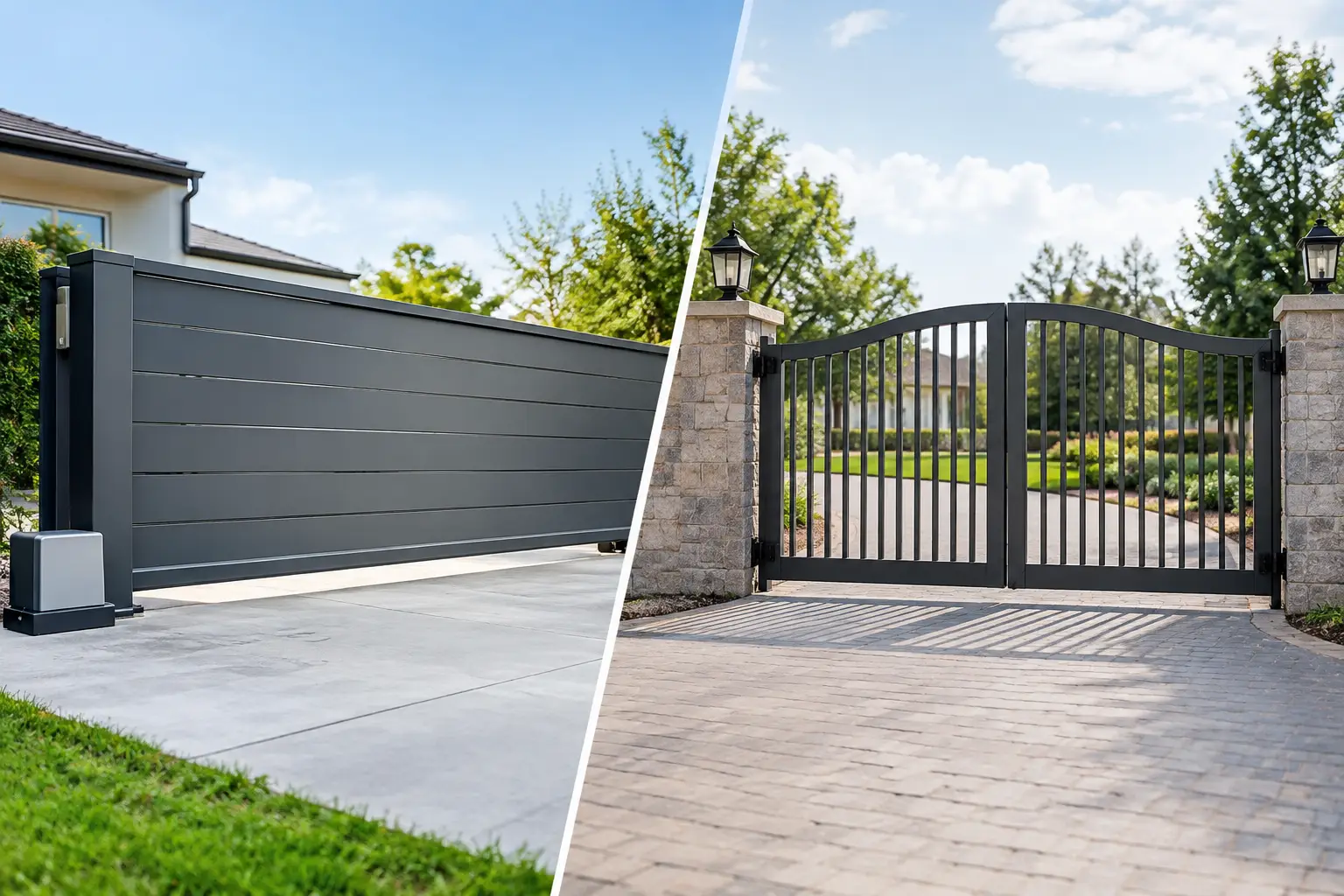
A swing gate opens on hinges, much like a large door. It can be a single leaf that swings in one direction or a double gate with two leaves meeting in the middle. Swing gates are familiar, adaptable, and often a practical choice for residential entrances and locations with limited room along the fence line.
A cantilever gate slides sideways along the fence line. Unlike a tracked sliding gate, it does not roll across the driveway opening on a ground track. The gate is supported by rollers mounted to substantial posts, allowing it to travel above the driveway surface. Its rear section extends beyond the opening as a counterbalance.
That construction is why cantilever gates are common at commercial, industrial, municipal, and high-traffic properties. They can cover wide openings and continue operating where a ground track could collect mud, gravel, leaves, ice, or debris. They do require enough clear fence-line space for the gate to slide open.
Start With the Space You Have
The physical layout of the entrance is usually the first deciding factor. A swing gate needs a clear opening arc. Nothing can sit within that arc when the gate operates: no parked vehicles, landscaping, retaining walls, equipment, or steep changes in grade. The gate should generally swing inward so it does not extend into a public road or interfere with passing traffic.
A cantilever gate needs clear horizontal runback beside the opening. Because of the counterbalance section, the required space is more than the driveway width. A 20-foot opening, for example, may need roughly 30 feet of clear fence line or more, depending on the gate design. That area must remain free of structures, trees, utilities, and terrain that prevents proper installation.
This distinction matters on narrow residential lots. A swing gate may be the better fit if there is little room along either side of the driveway. On a commercial site with a long straight perimeter, a cantilever gate often makes better use of the available area while keeping the drive lane clear.
Grade Changes Can Rule Out the Wrong Gate
Driveway grade deserves close attention. A swing gate can bind, drag, or strike the pavement if the driveway rises too quickly near the gate line. There are specialized options, including rising hinges and custom fabrication, but they add complexity and may not suit every layout.
Cantilever gates are elevated above the drive surface, so they are less affected by uneven pavement, gravel drives, standing water, and minor surface changes. They still need properly placed, deeply set support posts and a level travel path along the fence line. A sliding gate is not a shortcut around poor site preparation, but it can be a more dependable solution where the driveway surface is not perfectly flat.
Consider How Often the Gate Will Operate
A gate that opens twice a day has different demands than one serving dozens or hundreds of vehicles. For a private home, a well-built swing gate with a properly sized operator can provide years of dependable service. It is often a straightforward and attractive way to secure a driveway.
For active commercial entrances, cantilever gates frequently have the advantage. They are designed for repeated cycles, wide openings, and vehicle traffic that cannot wait while a gate leaf moves across the drive lane. The sliding motion also avoids the risk of a wind-loaded swing gate being pushed or pulled against its operator.
Traffic patterns matter as much as total volume. A delivery entrance may need a wider clear opening than an employee lot. A storage yard may need a gate that stays open while trucks stage or turn. A school, medical facility, or managed property may need credentialed access at certain hours and visitor entry at others. Gate design should follow the traffic plan rather than being selected solely by appearance.
Weather, Ground Conditions, and Maintenance
Northwest Arkansas and the River Valley see heavy rain, changing temperatures, wind, and muddy conditions. Those conditions can expose weaknesses in an improperly matched gate system.
Swing gates have fewer moving structural components, but their hinges, latch points, drop rods, and operators need regular inspection. Wind is a particular concern with solid privacy panels, vinyl infill, or broad ornamental panels. The larger the surface area, the more force wind places on posts, hinges, and automation equipment. Strong posts and correctly selected hardware are essential.
Cantilever gates avoid a ground track across the driveway, which is a major maintenance advantage on gravel drives or sites where debris is common. The rollers, guide assemblies, support posts, and gate frame still require periodic inspection and adjustment. Because these gates are larger structures, installation quality is especially important. Undersized posts or poorly designed frames can lead to sagging, difficult operation, and premature wear.
Neither option is maintenance-free. The better question is which maintenance burden fits the site. A swing gate may be simpler on a quiet, level residential entrance. A cantilever gate may reduce recurring cleanup and operational interruptions at a busy or debris-prone commercial entrance.
Security and Access Control Need to Work Together
A gate is only as effective as the system around it. The fence height, gate frame, latch or locking method, operator, safety devices, and access controls should be planned as one perimeter solution.
Both swing and cantilever gates can be automated with keypads, remotes, card readers, telephone entry systems, vehicle loops, and other access-control equipment. The operator must be sized for the gate weight, length, wind exposure, expected cycle count, and available power. Safety devices such as photo eyes, monitored edges, and entrapment protection are not optional details. They are central to a safe automated installation.
Cantilever gates often provide an advantage for wider secure entrances because they can cover substantial openings without a center obstruction. That can benefit truck yards, equipment storage sites, manufacturing facilities, and developments where a wide lane must remain clear. Swing gates can still be highly secure, especially when paired with strong steel frames, quality hinges, reliable locking hardware, and properly designed access control.
Cost: Look Beyond the Initial Gate Price
A swing gate is often less expensive at the outset, particularly for a modest residential opening. It generally uses less steel and fewer specialized structural components than a cantilever system. However, costs can rise when the site needs custom hinges, upgraded posts, additional paving work, or solutions for an uneven driveway.
Cantilever gates typically have a higher initial cost. The counterbalanced frame, rollers, guide hardware, larger posts, and extended fence-line space all contribute to the investment. For properties with high use, wide openings, rough ground conditions, or strong security requirements, that added cost may be justified by better long-term operation.
Automation should also be evaluated as part of the total project cost, not as an afterthought. The least expensive operator is rarely the right value if it is undersized for the gate or lacks the safety features required for the application. A properly designed system protects the gate, reduces service issues, and gives property owners more reliable control over access.
When a Swing Gate Is Usually the Better Choice
A swing gate is often the right answer when the driveway is relatively level, traffic volume is low to moderate, and there is not enough side room for a sliding gate. It works well for many residential driveways, small farms, private entrances, and properties where the gate style is part of the overall curb appeal.
It can also be a strong choice when a decorative look is the priority. Ornamental steel, wood, vinyl, and composite gate designs can be built into swing configurations that complement the fence and the home. The key is allowing enough room for the leaves to move freely and building the posts for the weight they will carry.
When a Cantilever Gate Is Usually the Better Choice
A cantilever gate is often worth considering for commercial yards, industrial properties, multifamily communities, warehouses, construction access points, and other locations with frequent traffic. It is especially useful where a ground track would be difficult to keep clear or where a wide opening is needed for trucks and equipment.
It also makes sense where driveway grade would interfere with a swing gate, provided the fence line has the necessary runback space. For security-focused sites, its commercial-grade construction and compatibility with access-control systems make it a practical long-term option.
A site visit is the best way to settle the decision. Ace Fence Company Inc. can evaluate the opening width, grade, fence line, traffic flow, material needs, and access-control requirements before recommending a gate system. A well-planned entrance should do more than close an opening - it should keep the property moving safely and securely for years to come.
Ready to Talk to a Real Fence Professional?
Free on-site estimates from the River Valley's most trusted fence company since 1963.