Cantilever Gate Purpose: Secure Access Without a Track
Learn the cantilever gate purpose, how trackless sliding gates work, and when they are the right choice for secure Arkansas properties and work sites.
A gate that drags through mud, gravel, ice, or storm debris can quickly become a security problem. That is the practical reason the cantilever gate purpose matters for many commercial, industrial, and high-use properties: it provides controlled vehicle access without requiring a ground track across the driveway.
Cantilever gates are commonly used where a traditional swing gate would take up too much room or where a rolling gate on wheels would be unreliable. Instead of riding on a track set into the drive, the gate is supported from one side and slides horizontally across the opening. The result is a clear entrance that can stay functional in the conditions Arkansas property owners know well.
What Is a Cantilever Gate?
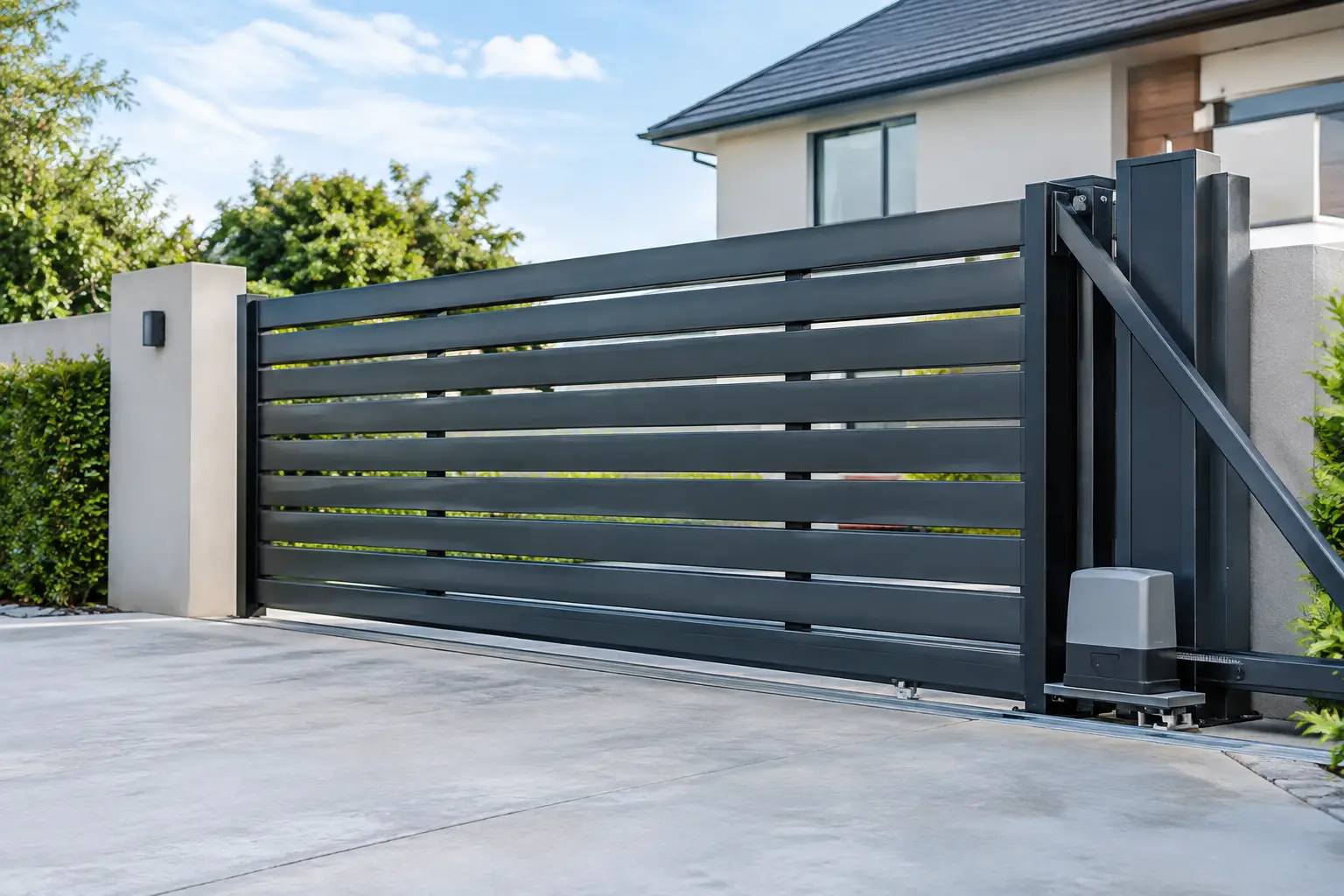
A cantilever gate is a sliding gate designed to travel above the ground. Its frame extends beyond the gate opening, creating a counterbalanced section that is supported by roller assemblies mounted to substantial posts. When the gate opens, the entire structure slides along the fence line rather than swinging into the drive or rolling across a track.
The opening itself remains clear. There is no rail for tires to cross, no wheel rolling through loose rock, and no trench-like track that can collect leaves, dirt, or water. This design makes a cantilever gate especially useful at entrances with regular vehicle traffic, uneven surfaces, or a need for dependable automated operation.
The counterbalance means a cantilever gate needs more room alongside the opening than the width of the driveway alone. A 20-foot opening, for example, requires additional space for the gate frame to travel when open. That space requirement is one of the first items to evaluate during site planning.
Cantilever Gate Purpose: Controlled Access That Stays Clear
The main purpose of a cantilever gate is to secure an entry point while maintaining a dependable path for vehicles. It creates a defined access point for employees, residents, delivery drivers, service vehicles, and authorized visitors, while helping keep unauthorized traffic out.
For a business yard, equipment lot, apartment community, utility site, or industrial facility, that control may be part of a broader perimeter-security plan. The gate can be manually operated for lower-traffic locations or paired with an automatic operator, keypad, card reader, remote control, telephone entry system, or other access-control equipment.
A cantilever gate is also useful because it avoids the clearance issues of a swing gate. A swing gate needs room inside or outside the property line to open. That can be difficult when a drive is short, a building sits near the entrance, vehicles park close to the gate, or a roadway limits how far a gate can swing. A sliding cantilever system keeps the movement parallel to the fence line.
Why a Trackless Design Makes a Difference
Traditional slide gates often use wheels that roll along a metal track installed across the driveway. That approach can work in the right setting, but the track needs to remain reasonably clean and level. Gravel, mud, runoff, leaves, and damaged pavement can interfere with the gate's travel.
A cantilever system eliminates that ground track. The gate is carried by rollers attached to posts, keeping the bottom of the gate elevated as it moves. This can reduce day-to-day problems at sites with unpaved drives, heavy rain, frequent truck traffic, or debris blown across the entrance.
That does not mean cantilever gates are maintenance-free. Hinges are not the concern with this style of gate, but rollers, guide hardware, operator components, safety devices, and the gate frame still need periodic inspection. Proper installation is especially important because the support posts and concrete footings carry significant weight and force each time the gate operates.
Better clearance for work vehicles
Forklifts, trailers, dump trucks, service trucks, and equipment haulers can be hard on an entrance. A ground track can be exposed to impact, shifting surfaces, or accumulated material. By keeping the gate's working components off the drive surface, a cantilever design often provides a better fit for active commercial and industrial properties.
A cleaner option for uneven or unpaved drives
Not every secured entrance has finished pavement. Farms, storage yards, construction sites, utility areas, and back-lot access points may use gravel or compacted soil. Cantilever gates can be a practical choice where maintaining a perfectly clean track would be difficult.
Where Cantilever Gates Are Commonly Used
Cantilever gates are most often associated with commercial and security-focused installations, but their use is not limited to large facilities. The right application depends on the size of the opening, traffic volume, security needs, available side room, and budget.
They are regularly installed at equipment yards, warehouses, manufacturing sites, storage facilities, schools, utility properties, distribution areas, and multi-family communities. Contractors and developers may also use them to control access to job sites, private drives, or restricted service areas.
For residential properties, a cantilever gate can make sense on a long driveway, estate entrance, acreage, or property where a wide vehicle opening is needed. However, it is usually more gate than a typical backyard driveway requires. A swing gate may be the more economical choice when there is adequate clearance and traffic is light.
Important Trade-Offs Before Choosing One
A cantilever gate solves specific problems, but it is not automatically the best gate for every entrance. It generally costs more than a simple swing gate because of its heavier frame, longer overall length, larger posts, roller hardware, and foundation requirements. Automation, access-control devices, safety loops, photo eyes, and electrical work can add further cost.
Space is another key consideration. The gate needs a clear run-back area beside the opening. Landscaping, slopes, buildings, utility equipment, parked vehicles, and corners in the fence line can all affect whether there is enough room for the gate to fully open.
The gate's size also matters. Wider openings require longer, heavier gate frames and more substantial support structure. A properly designed system accounts for wind exposure, gate weight, traffic patterns, fence height, and the operator selected for the job. Trying to use light-duty hardware on a heavy or frequently used gate leads to poor performance and premature repairs.
Appearance may factor into the decision as well. Cantilever gates are often built with chain link infill for commercial security, but they can also be fabricated with ornamental steel, wood, vinyl, composite materials, or custom panels where appearance is a priority. The gate should match the surrounding fence while still meeting the demands of the entrance.
Planning a Cantilever Gate Installation
A good installation starts with the site, not a catalog picture. The driveway width must be measured, but so must the available run-back space, slope, drainage, surface condition, utility locations, and vehicle turning needs. A gate that looks properly sized on paper may not work if a delivery truck cannot clear it safely or if the open gate blocks another access point.
For automated gates, safety planning is essential. Commercial-grade gate operators should be matched to the gate's weight, length, and expected daily cycles. Proper systems also use appropriate safety devices to detect vehicles or obstructions. Access controls should be placed where drivers can use them without creating an unsafe backup into a public road.
Local codes, fire access requirements, and property-specific rules may also affect the design. Commercial sites, neighborhoods, schools, and institutional properties can have requirements for emergency access, gate setbacks, visibility, or approved entry systems. Addressing these details before installation is far less expensive than modifying a finished gate later.
Choosing the Right Partner for the Job
A cantilever gate is part fence system, part structural installation, and often part access-control project. The posts, footings, hardware, gate frame, operator, electrical planning, and safety components need to work together. That is why the installer should understand both perimeter fencing and specialty gate systems.
Ace Fence Company Inc. helps property owners across Fort Smith, Northwest Arkansas, and the River Valley evaluate these details before installation. For a simple manual entry gate or a controlled commercial entrance, the goal is the same: build a system that fits the site, performs as intended, and holds up to regular use.
If a driveway needs dependable access control but ground tracks, swing clearance, or rough conditions are creating problems, a site evaluation can determine whether a cantilever gate is the practical answer.
Ready to Talk to a Real Fence Professional?
Free on-site estimates from the River Valley's most trusted fence company since 1963.