
Best Gates for Warehouses: A Practical Guide
Choosing the best gates for warehouses means balancing traffic, security, site layout, and uptime. Compare sliding, cantilever, swing, and lift options.
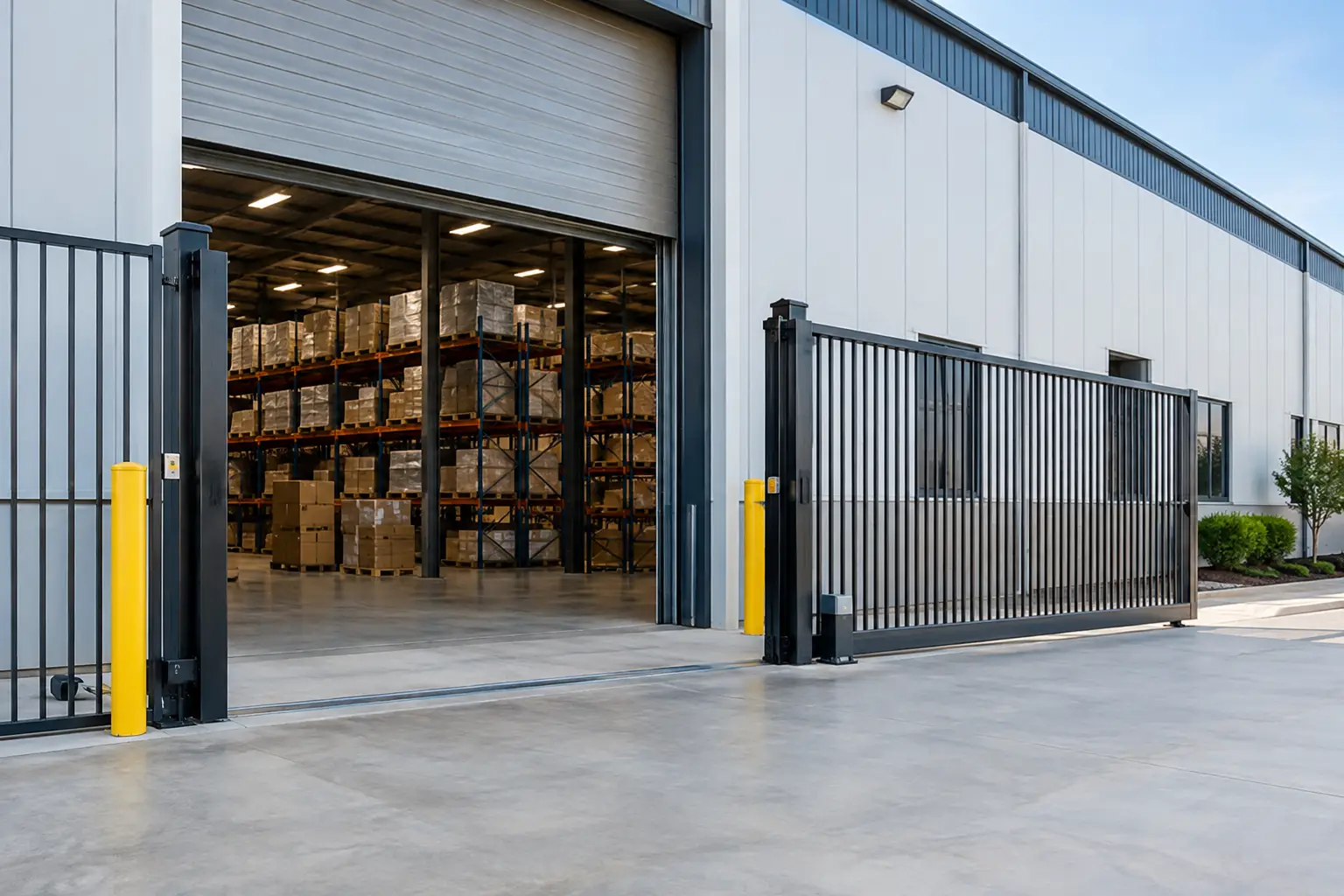
A warehouse gate has to do more than close an opening. It has to keep trucks, employees, deliveries, and visitors moving while protecting inventory, equipment, and the people on site. The best gates for warehouses are the ones matched to the property’s traffic pattern, available space, security requirements, and daily operating schedule.
A gate that looks appropriate on a site plan can become a daily problem if it blocks truck turns, requires too much clearance, or cannot handle frequent cycles. Before selecting a system, warehouse owners and property managers should consider how the entrance actually works during the busiest part of the day.
Start With Traffic and Site Layout
The right gate style depends heavily on the opening itself. Measure the clear opening needed for delivery trucks, trailers, forklifts, employee vehicles, and emergency access. A gate opening that works for passenger cars may be too narrow for a tractor-trailer making a wide turn from the street.
Also consider where vehicles queue. If drivers must stop before entering, there needs to be room for them to wait without backing into a public road or blocking a loading area. On busy warehouse properties, the gate location, approach angle, and operator speed can matter as much as the gate material.
A straightforward swinging gate may work well at a low-traffic warehouse with plenty of interior clearance. A site with frequent truck movement, limited room, or uneven ground often needs a sliding or cantilever system instead. There is no single best choice for every facility.
Best Gates for Warehouses by Application
Cantilever Sliding Gates
Cantilever gates are often a strong choice for commercial and industrial warehouse entrances. Unlike a traditional sliding gate, a cantilever gate does not roll along a ground track. The gate panel is supported above the driveway by rollers mounted to support posts.
That design is useful where gravel, mud, ice, debris, or drainage runoff could interfere with a track. Warehouses with heavy vehicle traffic also benefit from having no track across the driveway for trucks to cross repeatedly.
The trade-off is space. A cantilever gate requires room along one side of the opening for the gate to travel when open. The total runback area is typically longer than the driveway opening itself because of the counterbalance section. A contractor should verify that the fence line, utilities, grade, and nearby structures leave enough room for proper operation.
Track Sliding Gates
A track sliding gate moves on wheels along a track installed across the entrance. It can be a practical option where side room is available and the site conditions are controlled. For a wide opening, this style can provide reliable operation with less structural overhang than a cantilever design.
Its limitation is maintenance. Tracks need to stay clear of gravel, leaves, snow, mud, and other debris. At a warehouse with frequent truck traffic or an unpaved entrance, that cleaning requirement may become a recurring issue. Track gates are best suited to paved, well-maintained entrances where facility staff can keep the travel path clear.
Swing Gates
Swing gates remain a good fit for smaller warehouse entrances, secondary access points, and facilities with lower vehicle volume. They can be single leaf or double leaf, depending on the width of the opening and the room available inside the property.
A double swing gate can cover a wide entrance without requiring a long fence line for gate storage. However, the leaves need clear space to swing. They should not open into public traffic, and they need enough setback from the road for a vehicle to wait safely while the gate opens.
Swing gates can be manually operated on low-use entrances, but an automated operator is generally more practical for employee or delivery access. Wind exposure, grade changes, and the size and weight of the leaves all need attention during design. Large swing gates require properly sized posts, hinges, operators, and safety equipment.
Vertical Pivot Lift Gates
Vertical pivot lift gates raise upward instead of sliding sideways or swinging across the drive. They are especially useful when there is little or no room beside the gate opening. For a tight warehouse site, a vertical lift design can preserve valuable space along the fence line.
These systems are commonly considered for high-security entrances, constrained industrial properties, and locations where vehicle traffic needs a wide clear path. They can also be a good answer when the ground conditions make a track system impractical.
The primary consideration is overhead clearance. Building overhangs, power lines, signs, trees, and other obstructions must be reviewed carefully. Vertical lift systems also require specialized fabrication and installation, so they should be planned around the site rather than added as an afterthought.
Choose Materials That Match the Security Level
For many warehouse sites, chain link fencing with a commercial gate frame is a practical starting point. It provides visibility, defines the perimeter, and can be built in heights and configurations suited to the property. Privacy slats, barbed wire, or other security additions may be appropriate depending on the location and operational needs.
Where appearance and higher perimeter security are both priorities, ornamental steel fencing and gates may be a better fit near office entrances, customer-facing areas, or development sites. Industrial gates can also be fabricated to work with existing fence materials and access-control equipment.
Material selection should account for gate weight. A solid privacy infill, for example, catches more wind than open chain link. That added force affects the posts, hinges, rollers, operator, and foundation requirements. Heavier is not automatically better if the system is not engineered for the conditions it will face.
Automation Should Support Operations, Not Slow Them Down
An automated gate operator can improve control at a warehouse entrance, but only when it is sized for the gate and expected cycle count. A gate that opens a few times each morning has different demands than one used by employees, vendors, and freight carriers throughout the day.
Access methods may include keypads, card or fob readers, remote controls, telephone entry systems, intercoms, and vehicle detection loops. Some properties need separate entry and exit controls so outbound traffic can leave without requiring a code or staff intervention. Others need scheduled access rules for shift changes or after-hours deliveries.
Safety equipment is part of the system, not an optional add-on. Photo eyes, monitored edge devices, warning signs, proper gate spacing, and emergency release procedures help reduce the risk of a gate contacting a vehicle or person. A commercial gate should be installed and adjusted with the operator manufacturer’s safety requirements in mind.
Plan for Trucks, Fire Access, and Daily Maintenance
Warehouse gate decisions should be made with the fire lane, emergency access plan, and local code requirements in view. Emergency responders may need a specific clear width, approved access controls, or a gate that can be opened quickly during an incident. This should be addressed before installation, not after a final inspection raises a concern.
Maintenance also deserves a place in the budget. Gates are moving equipment exposed to weather, vehicle vibration, and repeated use. Hinges, rollers, tracks, operators, access devices, and safety sensors all need periodic inspection. A well-built system lasts longer when small alignment issues and worn components are handled early.
For warehouse managers, the best approach is to treat the gate as part of the facility’s operating equipment. Keep the travel area clear, train employees on access procedures, report unusual noises or slow movement, and avoid forcing a gate that is not operating correctly.
Work With a Contractor Who Can Design the Whole Entrance
A warehouse entrance is more than a gate panel and an operator. It may include fence transitions, bollards, access controls, pedestrian protection, concrete pads, safety devices, and custom fabrication. Coordinating those parts upfront prevents costly changes after the fence and gate are already in place.
Ace Fence Company Inc. helps commercial and industrial clients across Fort Smith, Northwest Arkansas, and the River Valley evaluate practical options for sliding, cantilever, swing, and specialty gate systems. The right recommendation starts with a site review, a clear understanding of traffic, and an honest discussion about security needs and budget.
A gate should make the workday easier, not create a new bottleneck at the entrance. When planning a warehouse project, bring the truck routes, access needs, future expansion plans, and maintenance expectations into the first conversation so the finished system can serve the property for years.
Ready to Talk to a Real Fence Professional?
Free on-site estimates from the River Valley's most trusted fence company since 1963.