Best Fences for Windy Yards That Hold Up
Choosing the best fences for windy yards starts with wind load, post depth, and the right material. Compare options that protect your property well.
A strong gust can turn a poorly planned fence into a line of leaning posts, loose panels, and damaged gates. The best fences for windy yards are not chosen on appearance alone. They are selected and installed around the amount of airflow the fence allows, the soil conditions on site, post depth, fence height, and the way gates will be used.
For homeowners and property managers in the River Valley and Northwest Arkansas, wind is only one part of the job. Heavy rain can soften soil around posts, uneven ground can complicate panel placement, and a wide driveway opening can put added pressure on a gate system. A fence that performs well starts with the right design, then depends on careful installation.
Why Wind Damages Some Fences Faster Than Others
Wind pushes against a fence like water against a dam. The more solid surface a fence presents, the more force its posts, rails, fasteners, and gates must resist. A tall, solid privacy fence may provide the seclusion a backyard needs, but it also catches far more wind than an open ornamental or chain link fence.
That does not mean a solid fence is the wrong choice. It means the structure behind the boards or panels has to be designed for the load. Posts must be properly sized and set deep enough for the soil and fence height. Rails need secure connections. Corners, ends, and gate posts need extra attention because they carry more stress than a straight run of fence.
Wind also finds weak points. A fence can look sound until a loose board begins to move, a post starts to shift, or an undersized gate frame twists. Addressing those details during installation is far more practical than repairing storm damage later.
Best Fences for Windy Yards
The right material depends on whether your priority is privacy, security, appearance, containment, or controlled access. In many cases, an open-style fence is the most wind-friendly option. Where privacy is necessary, the installation method becomes even more important.
Chain Link Fencing
Chain link is one of the most dependable choices for exposed yards, commercial sites, athletic areas, and properties that need reliable enclosure without blocking the wind. Its open mesh allows air to pass through instead of creating a solid wall of resistance.
A properly built chain link fence uses line posts, terminal posts, tension wire, fabric, and fittings that work together to keep the fence tight. It is a practical option for pet containment, lot boundaries, equipment areas, and commercial perimeters. Privacy slats or windscreen can be added when needed, but those additions increase wind load and should be considered as part of the overall fence design.
Ornamental Metal Fencing
Ornamental fencing provides a cleaner, more formal look while maintaining open spacing between pickets. That spacing is an advantage in windy locations because air can move through the fence rather than press against a solid surface.
This type of fencing is often a strong fit for front yards, pool enclosures, commercial entrances, multifamily properties, and sites where visibility matters. It can define a property and improve security without making the entrance feel closed off. The posts and gate framework still matter, especially around long runs and drive gates, but the fence itself generally handles wind better than a full privacy design.
Wood Fencing With Airflow in Mind
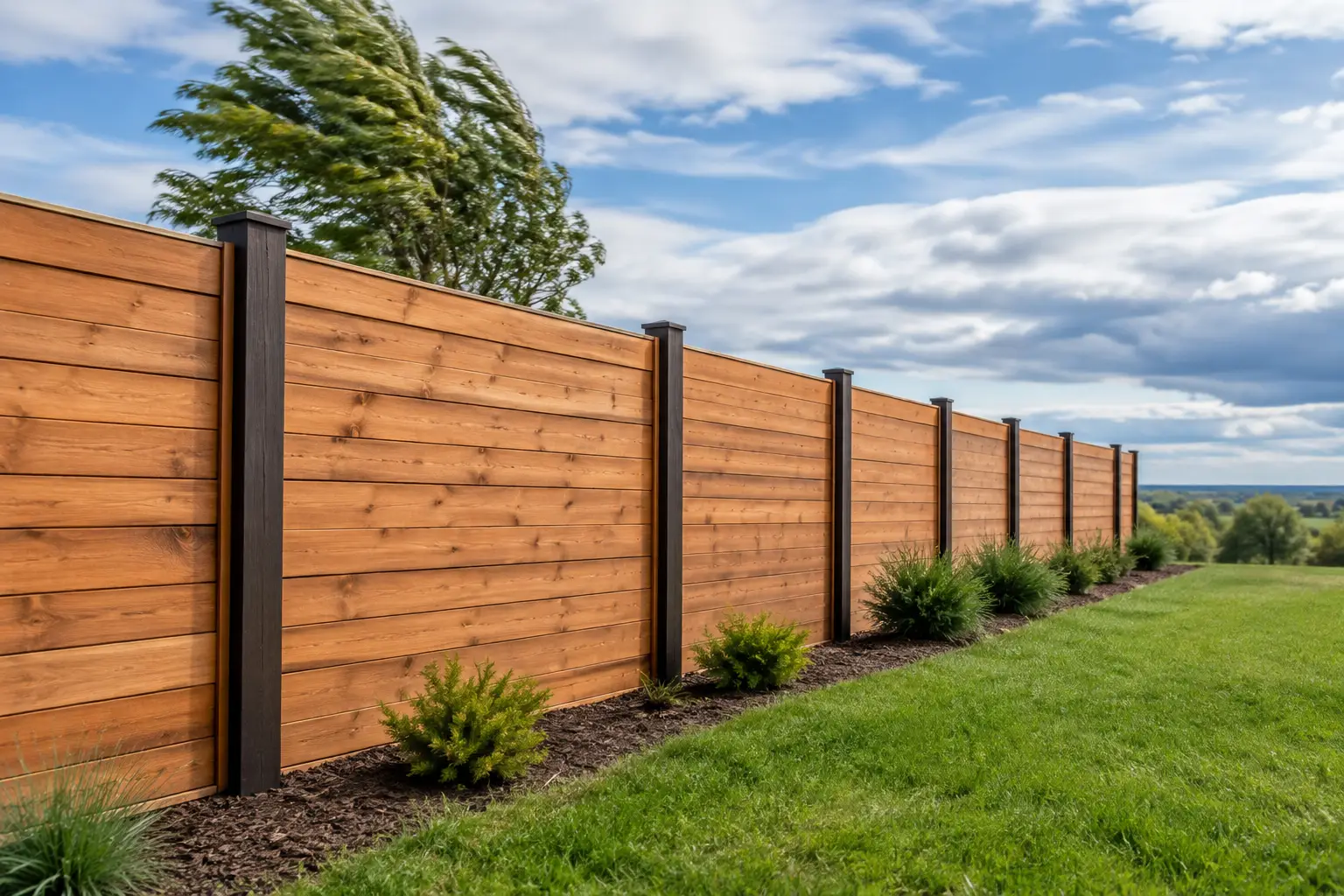
Wood remains a popular choice for residential privacy and traditional curb appeal. A standard solid-board privacy fence can perform well in a windy yard, but it needs substantial posts, appropriate spacing, secure rails, and a layout suited to the property. The taller and more solid the fence, the more carefully those structural details must be planned.
For properties with regular exposure, a board-on-board or shadowbox design may be worth considering. These styles overlap boards for privacy while leaving small spaces that can relieve some wind pressure. A spaced-picket design offers even more airflow, though it provides less privacy.
Wood also requires maintenance. Inspect it after major storms for loose boards, cracked rails, fastener movement, and posts that no longer stand plumb. Prompt repairs keep minor movement from becoming a larger structural issue.
Vinyl and Composite Fencing
Vinyl and composite fencing can provide a finished, low-maintenance appearance, but not every panel style is suited to a high-wind location. Solid privacy panels catch substantial wind, and their performance depends heavily on the post system, reinforcement, panel construction, and installation requirements for that particular product.
For an exposed backyard, a semi-private design with openings may be a better fit than a full solid panel. If the goal is a solid privacy fence, reinforced posts and a layout built for the site are essential. Vinyl and composite materials do not eliminate the need for sound structural work. In fact, their clean appearance can make it easy to overlook how much force the posts and rails are carrying.
Installation Details Matter as Much as Material
A fence material is only part of the answer. The same style can perform very differently based on how it is installed. Post depth should be based on fence height, ground conditions, local requirements, and expected loads. Shallow or poorly supported posts are a common reason fences lean after high winds or saturated ground.
Corner posts, end posts, and gate posts deserve special planning. These are the points where tension changes direction or where repeated movement occurs. A gate post that supports a heavy swing gate is doing more work than a standard line post. It must be set and braced accordingly.
Fence height also changes the equation. A six-foot privacy fence catches more wind than a four-foot open-picket fence. Adding a retaining condition, slope, elevated yard, or windscreen can increase the demands further. An on-site estimate is the right time to identify these conditions before material is ordered and holes are dug.
Drainage should be part of the conversation as well. Water that collects around posts can soften soil and contribute to movement over time. On sloped properties, the fence layout may need to step or rack with the grade so panels and posts remain properly supported.
Do Not Treat Gates as an Afterthought
Gates are often the first part of a fence to show stress. A pedestrian gate that drags, a double drive gate that will not meet in the center, or an automated entrance that binds during operation can all point to inadequate support or shifting posts.
For windy properties, gate size and gate type matter. A wide solid gate catches considerable wind when open or closed. Depending on the opening, a sliding, cantilever, or pivot lift gate may be more appropriate than a large swinging gate. Commercial and industrial sites may also need access-control equipment, safety features, and a gate system designed around daily traffic rather than occasional use.
Ace Fence Company Inc. can help evaluate fence and gate options together, which is especially useful when a project includes a driveway entrance, controlled access, or a long perimeter with changing terrain.
Choosing the Right Fence for Your Property
Start with the job the fence needs to do. If your main concern is containing pets or marking a boundary, chain link may be the sensible, wind-friendly choice. If you need a formal appearance and clear sightlines, ornamental fencing can offer security with less wind resistance. If privacy is nonnegotiable, wood, vinyl, or composite may still be right, but the posts, layout, and panel design should be selected with local exposure in mind.
It also helps to look beyond your own yard. Is the property on a ridge, beside open pasture, near a commercial lot, or at the end of a street where wind funnels through? Are there mature trees that shelter one side but leave another exposed? These real-world conditions are more useful than choosing a fence from a photo alone.
A well-built fence should fit the property, not force the property to fit a standard panel. Before committing to a style, have the site reviewed, explain how you use the space, and ask how the proposed posts and gates will handle wind and ground conditions. That conversation can make the difference between a fence that simply looks good on installation day and one that stays dependable through the seasons.
Ready to Talk to a Real Fence Professional?
Free on-site estimates from the River Valley's most trusted fence company since 1963.