Best Driveway Gate Features for Secure Access
Compare the best driveway gate features for Arkansas homes and businesses, from gate style and safety devices to dependable access control and proven value.
A driveway gate is more than an entrance marker. It controls who reaches the property, affects daily traffic flow, and becomes one of the first things visitors see. The best driveway gate features are the ones that fit the site, the level of security needed, and the way people actually use the entrance every day.
For a homeowner, that may mean a gate that keeps children and pets safely inside while adding curb appeal. For a business, farm, industrial site, or managed property, it may mean controlled access, dependable operation, and a system built to handle frequent vehicle traffic. The right answer is rarely just choosing the largest gate or the most complicated operator. It is building a complete gate system around the property’s real needs.
Start With the Right Gate Style
A gate’s operating style affects clearance, reliability, cost, and how well it works with the driveway. Before selecting access controls or decorative details, look closely at available space, driveway slope, traffic patterns, and the width required for vehicles and equipment.
Swing gates
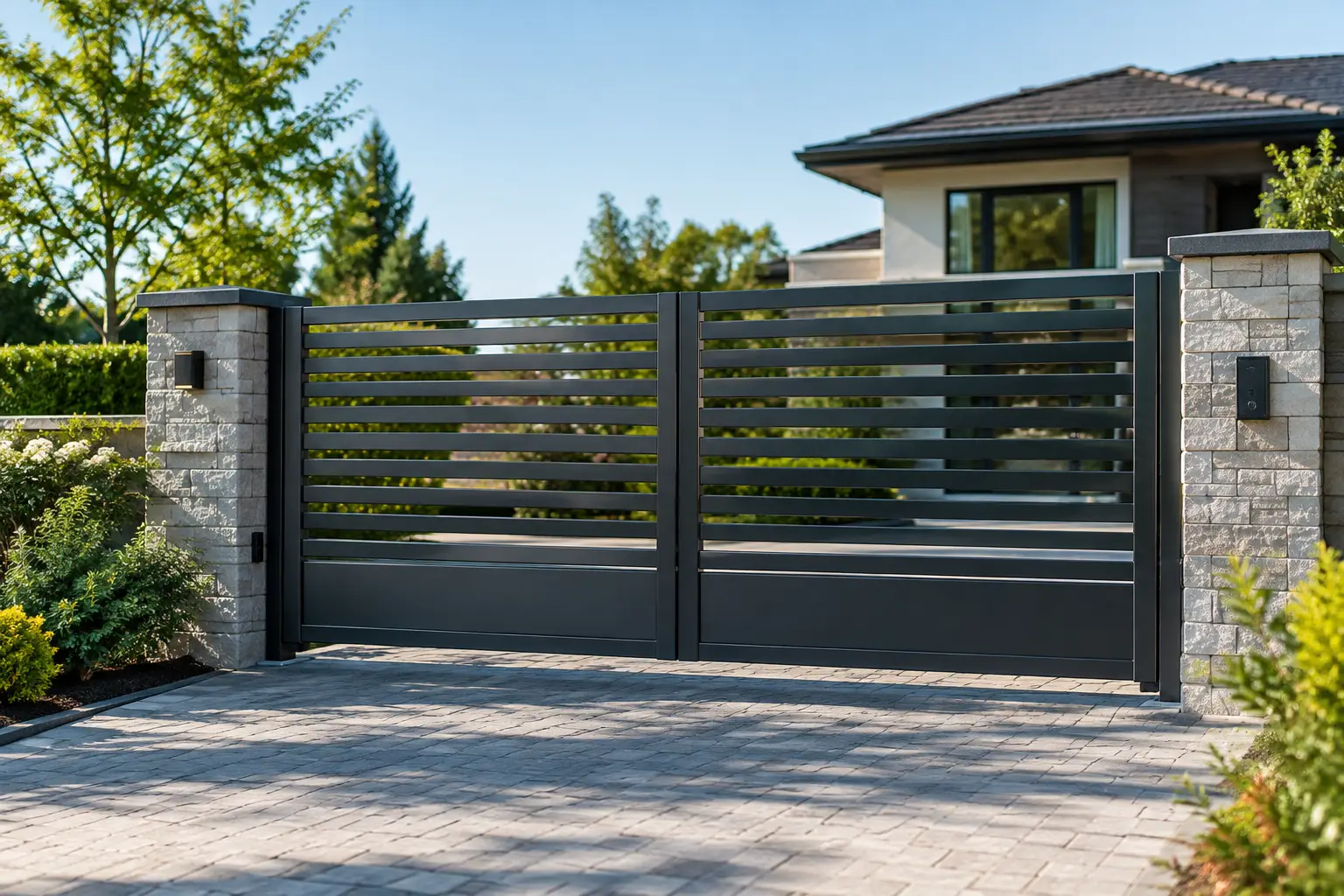
Swing gates are a practical choice when there is enough level space for the gate leaves to open inward or outward. A single swing gate can work well for narrower residential driveways, while a double swing gate provides a wider opening without requiring one oversized leaf.
They can be built in wood, ornamental steel or aluminum, vinyl, composite, or chain link configurations depending on the desired appearance and security level. The trade-off is that swing gates need clear space through their full path of travel. A sloped driveway, parked vehicles, or snow and debris in the swing area can create operating problems.
Sliding and cantilever gates
Sliding gates are often a better fit where driveway space is limited or vehicle traffic is heavier. A standard slide gate rolls along a track, while a cantilever gate is supported above the ground and does not require a track across the driveway.
Cantilever systems are especially useful for commercial and industrial properties because they avoid the issues that can come with gravel, mud, leaves, and debris collecting in a ground track. They do need additional room along the fence line for the gate to travel when open. That space requirement should be measured early, not after the fence layout is finalized.
Specialty gate systems
Some sites call for more than a standard swing or slide gate. Pivot lift gates, vertical lift gates, and other specialty systems can provide controlled access where space, grade, security requirements, or vehicle clearance makes traditional designs impractical. These systems are common at facilities with demanding access conditions, but they should be selected and installed by a contractor familiar with the equipment and site requirements.
Choose Materials That Match the Property
The gate frame and infill should be selected for more than looks. Weight, maintenance, exposure to weather, privacy needs, and operator capacity all matter.
Ornamental metal gates offer a traditional, durable appearance and can be fabricated in a wide range of styles. They are a strong choice for many residential entrances, commercial properties, and secured facilities. A properly built metal gate can provide visibility while still creating a defined, secure boundary.
Wood gates offer privacy and a natural look, particularly when tied into an existing wood fence. Their appearance can be appealing for residential properties, but wood is heavier than many alternatives and can shift over time with moisture and temperature changes. Hardware, posts, hinges, and operators must be sized correctly to carry that weight.
Vinyl and composite gates can complement low-maintenance fencing systems and provide privacy without the routine staining or painting associated with wood. Like any gate material, they need a properly engineered frame. A gate is a moving structure, and the internal support matters as much as the exterior finish.
Chain link gates remain a practical option for yards, storage areas, construction sites, athletic facilities, and commercial perimeters. They can be simple and economical, or upgraded with privacy slats, heavier framework, access-control equipment, and security-focused designs.
Safety Features Are Not Optional
Automatic gates add convenience, but they also introduce moving equipment at an active vehicle entrance. Safety should be part of the system design from the beginning, not an add-on considered after installation.
A well-planned automated driveway gate should include appropriate entrapment protection devices, such as photo eyes and reversing sensors, along with an operator designed for the gate’s weight, length, and expected cycle count. Photo eyes can detect a vehicle, person, or object in the gate opening. Other protective devices help the gate stop or reverse if it encounters an obstruction.
The operator also needs a reliable manual release. During a power outage or equipment issue, authorized users need a safe way to open the gate. For properties that depend on continuous access, battery backup or another planned power solution may be worth considering.
Gate safety also depends on the surrounding fence and layout. Gaps that allow a child to climb or reach into moving parts, improperly placed controls, and pinch points near hinges or rollers all need attention. Professional installation means looking at the entire entrance, not just mounting an operator on a finished gate.
Access Control Should Fit Daily Use
The best gate operator is not always the best access-control setup. Think about who needs entry, when they need it, and whether they arrive by car, truck, delivery vehicle, or on foot.
For a residence, a keypad, remote transmitter, or wireless entry system may provide the right balance of convenience and security. A keypad can be useful for family members, trusted service providers, or guests, but codes should be managed carefully and changed when access needs change.
For commercial properties, access control may involve keypads, card or fob readers, telephone entry systems, monitored controls, or approved vehicle-access devices. A property manager may need to issue and remove credentials for tenants or employees. A business with deliveries may need a separate procedure for vendors and freight traffic. The goal is to avoid a system that is secure on paper but frustrating enough that users start bypassing it.
Exit devices deserve the same level of planning. Free-exit loops, request-to-exit systems, and other exit controls can allow authorized traffic to leave without requiring drivers to stop and enter a code. The right equipment depends on the gate style, traffic volume, site layout, and local safety requirements.
Gate Size and Vehicle Clearance Matter
A gate opening that works for a passenger vehicle may be too narrow for a moving truck, trailer, service vehicle, or emergency response vehicle. This is one of the most common planning mistakes because the driveway may feel wide enough until a larger vehicle needs to turn in.
Consider the widest vehicles likely to use the entrance, including delivery trucks, work trailers, lawn equipment, and fire or utility access. Also consider the approach. A wide gate does little good if a vehicle cannot make the turn from the road without crossing a ditch, striking a post, or blocking traffic.
For commercial and agricultural sites, daily traffic patterns may justify separate entrance and exit lanes, wider clear openings, or a dedicated pedestrian access point. Planning these details early can prevent costly changes later.
Build for the Site, Not Just the Catalog Photo
Driveway gates put substantial force on posts, hinges, rollers, and foundations. Soil conditions, drainage, wind exposure, grade, and gate weight all affect how the system should be built. A decorative gate that looks right in a catalog may not perform well if its supporting structure is undersized for the location.
Drainage is especially worth discussing. Standing water near a track, operator, or gate post can create maintenance problems. On a sloped driveway, the direction of a swing gate and the placement of safety devices must be planned carefully. In rural areas, uneven ground, livestock traffic, and long distances from available power can influence the equipment selected.
Power is another early decision. Hardwired electric service is often the most dependable option for an automated gate, but it is not the only one. Solar-powered operators can be a useful solution where trenching power would be difficult or expensive, provided the site receives adequate sunlight and the system is sized for expected use. High-cycle commercial entrances may require more power capacity than a lightly used residential gate.
Plan for Service and Long-Term Reliability
A driveway gate is mechanical equipment exposed to weather and daily use. Hinges need adjustment, tracks need cleaning, safety devices need testing, and operators need periodic inspection. Selecting commercial-grade components for a high-use entrance can cost more at the start but often makes sense over the life of the system.
Ask how the gate will be serviced, how replacement parts are handled, and whether the selected operator is appropriate for the expected number of cycles each day. A residential operator on a busy business entrance is likely to wear out early. Likewise, an oversized industrial system may be unnecessary for a private driveway with a few daily openings.
For homeowners and property managers across Fort Smith, Northwest Arkansas, and the River Valley, a site visit is often the best way to sort through these choices. Ace Fence Company Inc. can help match the gate style, fencing material, operator, and access controls to the property instead of forcing a standard package onto every entrance.
The most useful driveway gate is one that opens when it should, protects the people and property behind it, and holds up to the work it is asked to do. Start with the driveway, the traffic, and the security goal, then build the gate system around those facts.
Ready to Talk to a Real Fence Professional?
Free on-site estimates from the River Valley's most trusted fence company since 1963.